
How to give an AI tutor your syllabus
To give an AI tutor your syllabus, add the syllabus and your course notes to its knowledge base, tell it your exam date and the topics you find hard, then ask it to question you instead of summarising for you. The questioning matters: in a well known memory study, students who tested themselves recalled 61% of a passage a week later, against 40% for students who only studied it again [1].
A general chatbot knows a lot about the world and nothing about your course. It does not know which chapters are on the exam, how your teacher marks, or which week you fell behind. The syllabus fills that gap, and it takes a few minutes to hand over.
This guide covers what to add, what to tell your tutor about yourself, and how to use it once it knows your course. The short version: give it the material, then let it test you.

Start with the syllabus, not a blank chat
Most people open an AI chat and type a question. For a course, that wastes the best thing you own: the document that says what will be tested. A syllabus lists the topics, the order, the weighting and the dates. Once your tutor has it, its answers follow your course instead of a textbook it has never seen.
In CreationX you do this by adding files to your Creation's knowledge base. You can upload a PDF, a Word file or plain notes, up to 25 MB each, and your Creation uses them when it answers you. Files you add are used only to answer you and are never used to train models.
If you have not made a tutor yet, describe one in a sentence, such as "a patient chemistry tutor for my first year exam in May". See how it works for the steps, or the study and exams page for examples.
What to add, and what to leave out
Add the syllabus first, then the material it points to: your own lecture notes, reading lists, the marking guide if your course publishes one, and past papers you are allowed to use. Short, clean files work better than one huge scan. If a document is mostly images, a typed summary of it will often help more than the scan itself.
Leave out anything that is not yours to share, such as classmates' work or anyone's personal details. Keep an eye on space as well. On the Free plan your knowledge bases hold up to 50 files and 50 MB in total across your Creations, so the syllabus and your best notes should come before every slide deck from the term.
Update the knowledge base when the course changes. If your teacher moves a topic or adds a reading, add the new file and delete the old one, so your tutor is not working from last month's plan.
Tell it the dates and the weak spots
A syllabus says what the course covers. It does not say what you find hard. Tell your tutor in plain words: the exam date, the topics that confuse you, and how you tend to slip, for example rushing timed questions or mixing up two similar terms.
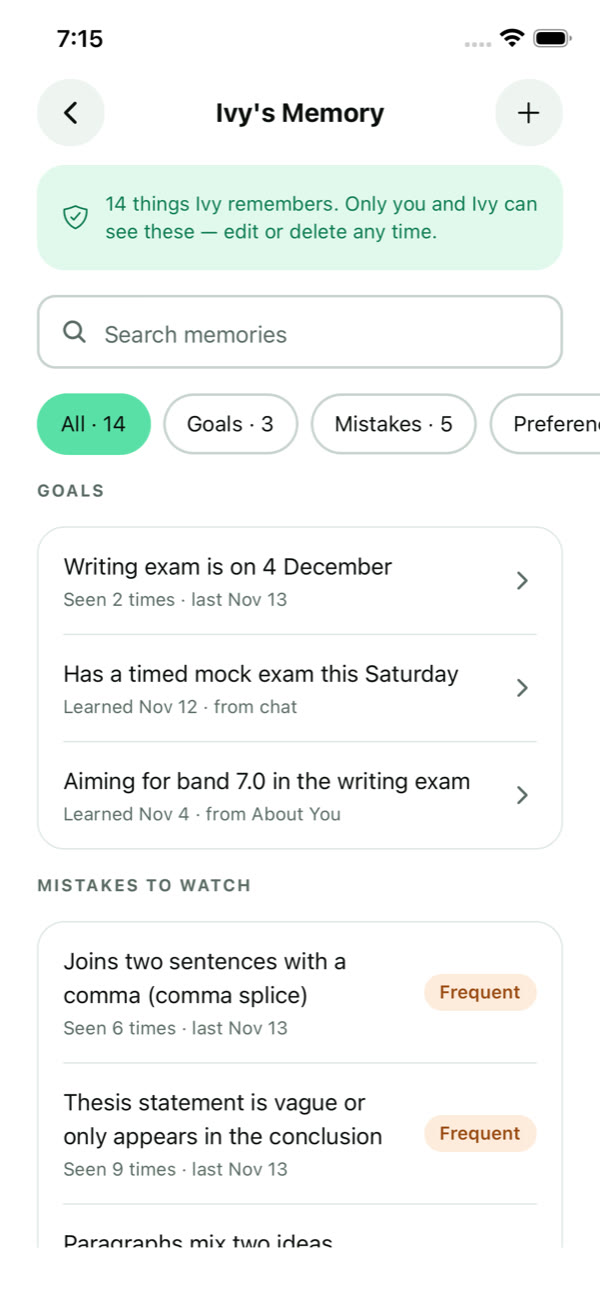
Your Creation remembers goals, preferences and recurring mistakes from your chats. You can open its memory at any time to see what it has kept, edit a line that is wrong, or delete one you do not want it to hold. That memory is what lets the next session pick up where the last one stopped.
Ask it to test you, not to summarise
Here is where most of the value is. It is tempting to ask an AI tutor for a neat summary of each chapter and read it twice. Reading feels productive. Research on memory says it is the weaker choice.
In 2006, the psychologists Henry Roediger and Jeffrey Karpicke had students study short prose passages and then either restudy them or take recall tests without feedback [1]. Five minutes later, the students who restudied did slightly better. A week later the result flipped: students who had taken three tests recalled 61% of the passage, while students who had only restudied recalled 40% [1][2]. The restudy group had also felt more confident that they would remember [1].
The authors drew a plain lesson for students: self-testing while studying is one powerful way to improve your own learning [3]. A 2013 review of common study techniques reached a similar view, rating practice testing and spreading study out over time as high utility, and rereading as low utility [4].
So ask for questions. Try "Ask me five questions on week three of my syllabus, one at a time, and wait for my answer before you explain". Answering from memory first, then checking, is the part that does the work.
A weekly rhythm that keeps the syllabus moving
Testing works best when it repeats over days, not in one long session the night before [4]. A simple weekly loop is enough: one short session on new material, one on last week's topics, and a quiz on the mistakes you keep making.
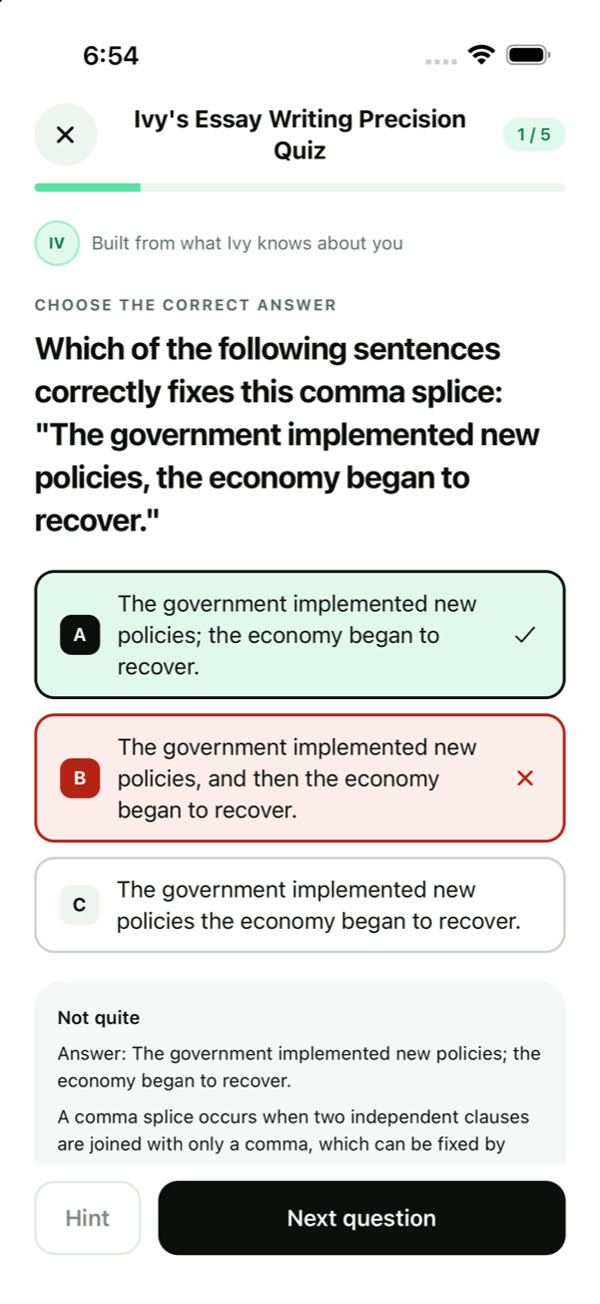
CreationX can hold that rhythm for you. Set a check-in schedule with the days and time you want, and quiet hours when it should stay silent. Quiz mode builds questions from what your Creation remembers about you, including your goals and recurring mistakes, and the progress screen shows your latest score and streak.
Keep the syllabus as the anchor. When you finish a unit, tell your tutor, and ask it what comes next on the list. That way the plan follows your course, not whatever you happened to ask about last.
Where an AI tutor stops
An AI tutor can be wrong, even with your notes in front of it. When an answer matters, such as a formula, a date or a definition, check it against the course material your tutor was given. Asking "which file did that come from?" is a good habit.
Follow your school's rules on AI. Many courses allow AI for practice and explanation but not for work you hand in. Using your tutor to question you is about as safe a use as there is, because the answers still have to come from you.
Questions on this page
Yes. CreationX accepts PDF, Word files and plain notes in a Creation's knowledge base, up to 25 MB per file, and the Creation uses them when it answers you.
No. Files you add to a Creation's knowledge base are used only to answer you and are never used to train models.
Questions. In a 2006 study, students who tested themselves recalled 61% of a passage a week later, against 40% for students who only restudied it.
Sources
- Test-Enhanced Learning: Taking Memory Tests Improves Long-Term Retention (Roediger and Karpicke, Psychological Science 17(3), 2006) · Psychological Science, copy hosted by East Carolina University · read 2026-11-14
- Repeated test-taking better for retention than repeated studying, research shows · Washington University in St. Louis · read 2026-11-14
- Test-enhanced Learning · Association for Psychological Science, Observer · read 2026-11-14
- Improving Students' Learning With Effective Learning Techniques (Dunlosky and others, 2013) · Association for Psychological Science · read 2026-11-14
This article is general information based on the public sources listed, as read on the date shown. It is not medical, legal, financial or academic advice. CreationX features are described as they work in the app today.